

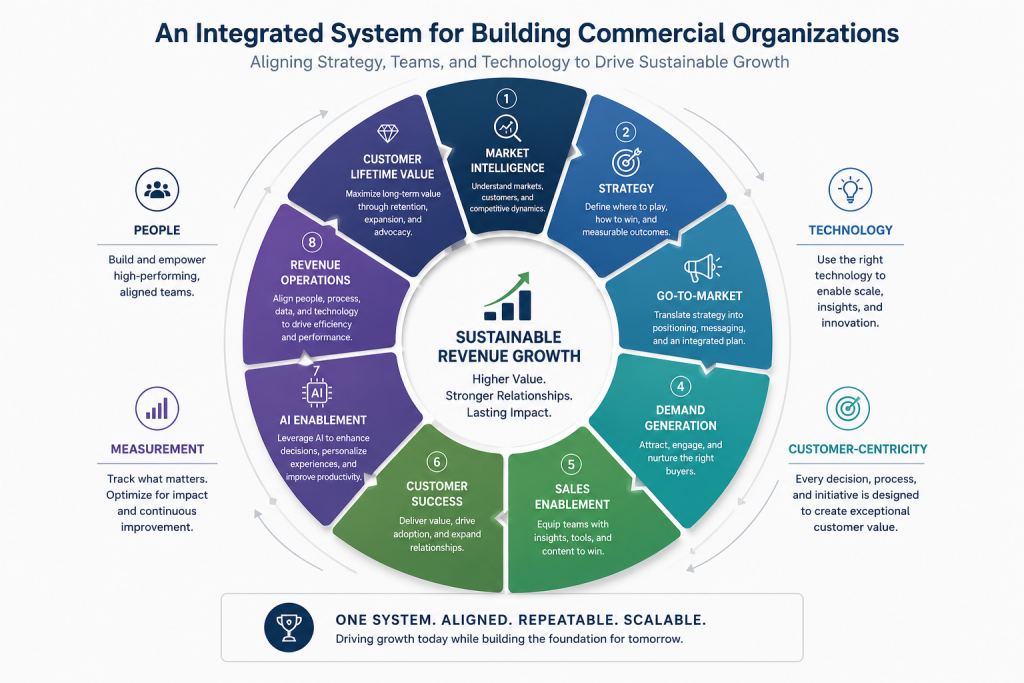
Throughout Joel’s career, he’s observed that the highest-performing commercial organizations consistently shared the same characteristics. Whether leading global marketing organizations, commercial transformations, or new market expansion, sustainable growth wasn’t driven by isolated marketing tactics or sales initiatives. It was created by aligning every commercial function around a common strategy, shared objectives, disciplined execution, and measurable outcomes.
Over more than two decades, he’s refined this integrated commercial operating model through experience across global B2B organizations. While every business is unique, the principles behind sustainable growth remain remarkably consistent.
Market Intelligence
Every successful commercial strategy begins with a deep understanding of the market. That means listening to customers, analyzing competitors, identifying emerging trends, monitoring regulatory changes, and uncovering unmet needs. Market intelligence transforms assumptions into informed decisions, enabling organizations to prioritize opportunities, reduce risk, and stay ahead of changing market conditions.
Strategy
Growth requires deliberate choices. Strategy defines where an organization will compete, how it will differentiate itself, and which investments will generate the greatest long-term value. Effective commercial strategies align business objectives, customer needs, and organizational capabilities into a clear roadmap that guides every subsequent decision.
Go-to-Market
A successful go-to-market strategy turns business objectives into customer engagement. It aligns positioning, messaging, pricing, channels, campaigns, and product launches around a common vision. By ensuring every customer interaction reinforces the same value proposition, organizations create stronger market awareness, accelerate adoption, and improve commercial execution.
Demand Generation
Sustainable growth is built on predictable pipeline creation. Demand generation combines digital marketing, content, events, partnerships, account-based marketing, and customer engagement to attract qualified prospects and nurture them through the buying journey. The objective is not simply generating leads, but creating measurable revenue opportunities.
Sales Enablement
Marketing and sales achieve the greatest results when they operate as one commercial organization. Sales enablement equips customer-facing teams with the insights, content, training, tools, and competitive intelligence needed to engage buyers with confidence, improve win rates, and shorten sales cycles.
Customer Success
The customer relationship doesn’t end at the sale, it begins there. Customer success focuses on adoption, retention, expansion, advocacy, and long-term partnership. Organizations that consistently deliver customer value strengthen loyalty, generate referrals, and create sustainable recurring revenue.
AI
Artificial intelligence is rapidly reshaping how commercial organizations operate. From market research and competitive intelligence to content creation, campaign optimization, predictive analytics, customer engagement, and workflow automation, AI enables teams to work smarter, make faster decisions, and deliver more personalized customer experiences. When integrated thoughtfully, AI becomes an accelerator across every stage of the commercial organization.
Revenue Operations
Revenue operations connects marketing, sales, customer success, finance, and technology through shared processes, data, systems, and performance metrics. By creating a single source of truth, organizations improve forecasting, increase operational efficiency, and ensure every commercial function is working toward common business objectives.
Customer Lifetime Value
Sustainable growth is measured not by a single transaction, but by the long-term value created throughout the customer relationship. Every decision, from market strategy and customer acquisition to service delivery and retention, should strengthen trust, increase loyalty, and expand customer lifetime value. When organizations consistently deliver exceptional experiences, revenue growth becomes the natural outcome.
The Foundation
While these nine capabilities form the commercial operating system, sustainable success depends on four foundational elements that support every stage of execution:
- People – Building empowered, high-performing teams aligned around shared goals.
- Technology – Leveraging modern platforms and AI to enable scale, visibility, and efficiency.
- Measurement – Tracking meaningful metrics that drive accountability, learning, and continuous improvement.
- Customer-Centricity – Keeping customer value at the center of every decision, process, and investment.
These foundational principles ensure the operating model remains adaptable, measurable, and focused on delivering long-term business outcomes.
Putting the System Into Action
No two organizations are identical, but the principles behind sustainable commercial growth are remarkably consistent. The most successful businesses align strategy, people, technology, and execution around a shared vision, creating organizations that are agile, customer-focused, and built to scale.
The frameworks that follow explore each component of this integrated operating model in greater depth, illustrating the methodologies, tools, and leadership approaches he has refined throughout his career to build commercial organizations that accelerate growth.
Explore the Executive Frameworks
The Commercial Growth Operating Model provides the strategic foundation. The Executive Frameworks explore each capability in greater depth, offering the methodologies, tools, and leadership approaches he’s refined throughout his career to build high-performing commercial organizations.
